About
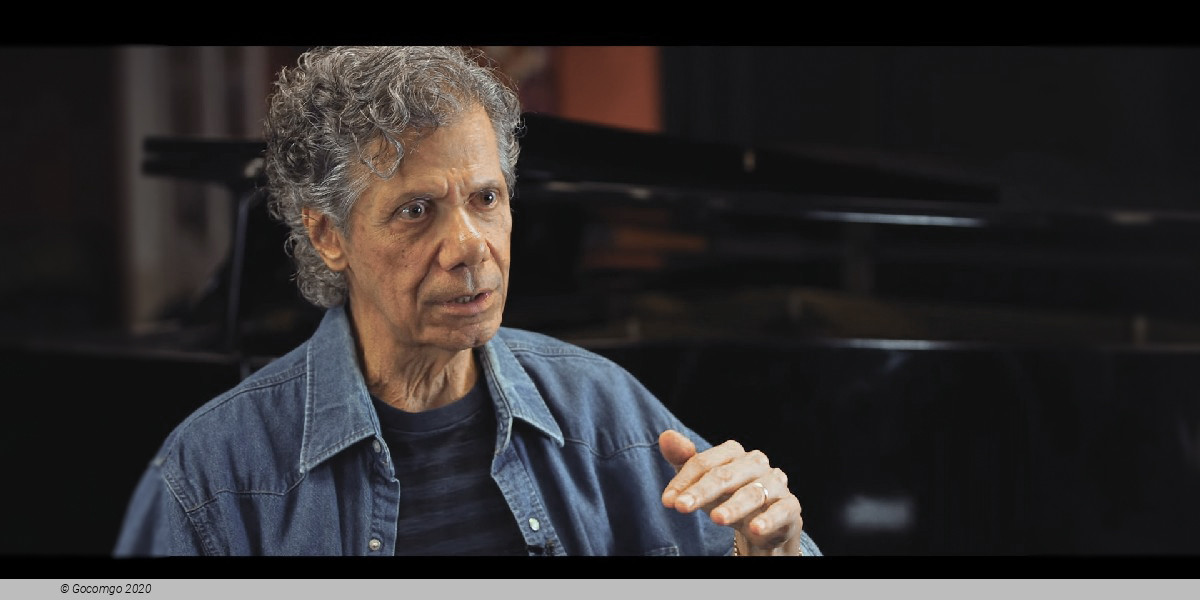
Armando Anthony "Chick" Corea is an American jazz pianist/electric keyboardist and composer. His compositions "Spain", "500 Miles High", "La Fiesta" and "Windows", are considered jazz standards. As a member of Miles Davis's band in the late 1960s, he participated in the birth of jazz fusion. In the 1970s he formed the fusion band Return to Forever. With Herbie Hancock, McCoy Tyner and Keith Jarrett, he has been described as one of the major jazz piano voices to emerge in the post-John Coltrane era.
Corea continued to pursue other collaborations and to explore musical styles throughout the 1980s and 1990s. He is also known for promoting and fundraising for a number of social issues.
Life and career
Youth
Armando Corea was born in Chelsea, Massachusetts. He is of southern Italian and Spanish descent. His father, a jazz trumpeter who led a Dixieland band in Boston in the 1930s and 1940s, introduced him to the piano at the age of four. Surrounded by jazz, he was influenced at an early age by bebop and Dizzy Gillespie, Charlie Parker, Bud Powell, Horace Silver, and Lester Young. At eight he took up drums, which would influence his use of the piano as a percussion instrument.
Corea developed his piano skills by exploring music on his own. A notable influence was concert pianist Salvatore Sullo, from whom Corea started taking lessons at age eight and who introduced him to classical music, helping spark his interest in musical composition. He also spent several years as a performer and soloist for the St. Rose Scarlet Lancers, a drum and bugle corps based in Chelsea.
Given a black tuxedo by his father, he started playing gigs when in high school. He enjoyed listening to Herb Pomeroy's band at the time and had a trio that played Horace Silver's music at a local jazz club. He moved to New York City, where he studied musical education for one month at Columbia University and six months at Juilliard. He quit after finding both disappointing, but he liked New York City and made it the starting point for his career.
Early career
Corea began his career in the early 1960s with Mongo Santamaria, Willie Bobo, Blue Mitchell, Herbie Mann, and Stan Getz. He released his debut album, Tones for Joan's Bones, in 1966. Two years later he released a trio album, Now He Sings, Now He Sobs, with Roy Haynes and Miroslav Vitous.
From 1968 to 1971 Corea had associations with avant-garde players, and his solo style revealed a dissonant orientation. In 1970 he played electric piano on Spaces, Larry Coryell's third album as a leader. The album was released on the Vanguard label with John McLaughlin on guitar, Miroslav Vitous on bass, and Billy Cobham on drums. The album was produced by Daniel Weiss and engineered by David Baker with assistance of Paul Berkowitz. Spaces is sometimes considered to have started the jazz fusion genre.
His avant-garde playing can be heard on his solo works of the period, his solos in live recordings under the leadership of Miles Davis, his recordings with Circle, and his playing on Joe Farrell's Song of the Wind album on CTI Records.
In September 1968 Corea replaced Herbie Hancock in Davis's band and appeared on Filles de Kilimanjaro, In a Silent Way, and Bitches Brew. In concert, Davis's rhythm section of Corea, Dave Holland, and Jack DeJohnette combined elements of free jazz improvisation and rock music. Corea experimented with using electric instruments, mainly the Fender Rhodes electric piano, in the Davis band.
In live performance he frequently processed the output of his electric piano with a device called a ring modulator. Using this style, he appeared on multiple Davis albums, including Black Beauty: Live at the Fillmore West and Miles Davis at Fillmore: Live at the Fillmore East. His live performances with the Davis band continued into 1970, with a touring band of Steve Grossman, tenor sax, Keith Jarrett, additional electric piano and organ, Jack DeJohnette, drums, Dave Holland, bass, Airto Moreira, percussion, and Davis on trumpet.
Holland and Corea left to form their own group, Circle, active in 1970 and 1971. This free jazz group featured multi-reed player Anthony Braxton and drummer Barry Altschul. This band was recorded on Blue Note and ECM. Aside from soloing in an atonal style, Corea sometimes reached into the body of the piano and plucked the strings. In 1971 or 1972 Corea struck out on his own. In April 1971 he recorded the sessions that became Piano Improvisations Vol. 1 and Piano Improvisations Vol. 2 for ECM.
The concept of communication with an audience became a big thing for me at the time. The reason I was using that concept so much at that point in my life – in 1968, 1969 or so – was because it was a discovery for me. I grew up kind of only thinking how much fun it was to tinkle on the piano and not noticing that what I did had an effect on others. I did not even think about a relationship to an audience, really, until way later.
Jazz fusion
In the early 1970s, Corea took a profound stylistic turn from avant-garde to a crossover jazz fusion style that incorporated Latin jazz with Return to Forever. Named after their eponymous 1972 album, the band relied on both acoustic and electronic instrumentation and drew upon Latin American styles more than on rock music. On their first two records, Return to Forever consisted of Flora Purim on vocals, Joe Farrell on flute and soprano saxophone, Airto Moreira on drums , and Stanley Clarke on double bass. Drummer Lenny White and guitarist Bill Connors later joined Corea and Clarke to form the second version of the group, which expanded the earlier Latin jazz elements with a more rock and funk-oriented sound inspired by the Mahavishnu Orchestra, led by his Bitches Brew bandmate John McLaughlin. This incarnation of the group recorded the album Hymn of the Seventh Galaxy, before Connors' departure and replacement by Al Di Meola, who was present on the subsequent releases Where Have I Known You Before, No Mystery, and Romantic Warrior.
Corea's composition "Spain" appeared on the 1972 Return to Forever album Light as a Feather. This is probably his most popular piece, and it has been recorded by a variety of artists. There are also a variety of recordings by Corea himself. These included an arrangement for piano and symphony orchestra that appeared in 1999 and a collabration with vocalist Bobby McFerrin on the 1992 album Play. Corea usually performs "Spain" with a prelude based on Joaquín Rodrigo's Concierto de Aranjuez (1940), which earlier received a jazz orchestration on Davis and Gil Evans' Sketches of Spain.
In 1976, he issued My Spanish Heart, influenced by Latin American music and featuring vocalist Gayle Moran (Corea's wife) and electric violinist Jean-Luc Ponty. The album combined jazz and flamenco, supported by Minimoog backup and a horn section.
Duet projects
In the 1970s Corea started working with vibraphonist Gary Burton, with whom he recorded several duet albums for ECM, including 1972's Crystal Silence. They reunited in 2006 for a concert tour. A new record called The New Crystal Silence was issued in 2008 and won a Grammy Award in 2009. The package includes a disc of duets and another disc with the Sydney Symphony Orchestra.
Toward the end of the 1970s, Corea embarked on a series of concerts and two albums with Hancock. These concerts were presented in elegant settings with both pianists dressed formally and performing on Yamaha concert grand pianos. The two traded playing each other's compositions, as well as pieces by other composers such as Béla Bartók. In 1982, Corea performed The Meeting, a live duet with the classical pianist Friedrich Gulda.
In December 2007 Corea recorded a duet album, The Enchantment, with banjoist Béla Fleck. Fleck and Corea toured extensively for the album in 2007. Fleck was nominated in the Best Instrumental Composition category at the 49th Grammy Awards for the track "Spectacle".
In 2008 Corea collaborated with Japanese pianist Hiromi Uehara on the live album Duet (Chick Corea and Hiromi). The duo played a concert at Tokyo's Budokan arena on April 30.
In 2015 he reprised the duet concert series with Hancock, again sticking to a dueling-piano format, though both also had synthesizers at their station. The first concert in this series was played at the Paramount Theatre in Seattle and included improvised music, songs by the duo, and standards by other composers.
Later work
Corea's other bands include the Chick Corea Elektric Band, its traditional jazz trio reduction called Akoustic Band, Origin, and its traditional jazz trio reduction called the New Trio. Corea signed a record deal with GRP Records in 1986 which led to the release of ten albums between 1986 and 1994, seven with the Elektric Band, two with the Akoustic Band, and a solo album, Expressions.
The Akoustic Band released a self-titled album in 1989 and a live follow-up, Alive in 1991, both featuring John Patitucci on bass and Dave Weckl on drums. It marked a turn back toward traditional jazz in Corea's career, and the bulk of his subsequent recordings have been acoustic ones. The Akoustic Band has toured intermittently, internationally since 1986. They also provided the music for the 1986 Pixar short Luxo Jr. with their song "The Game Maker".
In 1992 Corea started his own label, Stretch Records.
In 2001 the Chick Corea New Trio, with Avishai Cohen and Jeff Ballard on bass and drums, respectively, released the album Past, Present & Futures. The 11-song album includes only one standard composition (Fats Waller's "Jitterbug Waltz"). The rest of the tunes are Corea originals. He participated in 1998's Like Minds with Gary Burton on vibes, Pat Metheny on guitar, Dave Holland on bass and Roy Haynes on drums.
During the latter part of his career Corea became more interested in contemporary classical music. He composed his first piano concerto – and an adaptation of his signature piece, "Spain", for a full symphony orchestra – and performed it in 1999 with the London Philharmonic Orchestra. Five years later he composed his first work not to feature any keyboards: his String Quartet No. 1 was specifically written for the Orion String Quartet and performed by them at 2004's Summerfest in Wisconsin.
Corea has continued releasing jazz fusion concept albums such as To the Stars (2004) and Ultimate Adventure (2006). The latter album won the Grammy Award for Best Jazz Instrumental Album, Individual or Group.
In 2008, the third version of Return to Forever (Corea, keyboards; Stanley Clarke, bass; Lenny White, drums; Al Di Meola, guitar) reunited for a worldwide tour. The reunion received positive reviews from most jazz and mainstream publications. Most of the group's studio recordings were re-released on the compilation Return to Forever: The Anthology to coincide with the tour. A concert DVD recorded during their performance at the Montreux Jazz Festival was released in May 2009. He also worked on a collaboration CD with the vocal group The Manhattan Transfer.
A new group, the Five Peace Band, began a world tour in October 2008. Corea had worked with McLaughlin in Davis's late 1960s bands, including the group that recorded Davis's album Bitches Brew. Joining Corea and McLaughlin were saxophonist Kenny Garrett and bassist Christian McBride. Drummer Vinnie Colaiuta played with the band in Europe and on select North American dates; Brian Blade played all dates in Asia and Australia, and most dates in North America. The variety of Corea's music was celebrated in a 2011 retrospective with Corea playing with the Jazz at Lincoln Center Orchestra in the Lincoln Center for the Performing Arts; a New York Times reviewer had high praise for the occasion: "Mr. Corea was masterly with the other musicians, absorbing the rhythm and feeding the soloists. It sounded like a band, and Mr. Corea had no need to dominate; his authority was clear without raising volume."
A new band for 2013, Chick Corea & The Vigil, featured Corea with bassist Hadrien Feraud, Marcus Gilmore on drums (carrying on from his grandfather, Roy Haynes), saxes, flute, and bass clarinet from Tim Garland, and guitarist Charles Altura.
Corea celebrated his 75th birthday in 2016 by playing with more than 20 different groups during a six-week stand at the Blue Note Jazz Club in Greenwich Village, New York City. "I pretty well ignore the numbers that make up 'age'. It seems to be the best way to go. I have always just concentrated on having the most fun I can with the adventure of music."