

The Book of Mormon (Prince of Wales Theatre) tickets 2 December 2026 - The Book of Mormon | GoComGo.com

The Book of Mormon

The Book of Mormon (Prince of Wales Theatre), London, Great Britain
All photos (9)
Select date and time
7:30 PM
From
US$ 243

E-tickets: Print at home or at the box office of the event if so specified. You will find more information in your booking confirmation email.

You can only select the category, and not the exact seats.
If you order 2 or 3 tickets: your seats will be next to each other.
If you order 4 or more tickets: your seats will be next to each other, or, if this is not possible, we will provide a combination of groups of seats (at least in pairs, for example 2+2 or 2+3).

Important Info
Type: Musical
City: London, Great Britain
Starts at: 19:30
Acts: 2
Intervals: 1
Duration: 2h 20min

E-tickets: Print at home or at the box office of the event if so specified. You will find more information in your booking confirmation email.

You can only select the category, and not the exact seats.
If you order 2 or 3 tickets: your seats will be next to each other.
If you order 4 or more tickets: your seats will be next to each other, or, if this is not possible, we will provide a combination of groups of seats (at least in pairs, for example 2+2 or 2+3).

Cast
Creators
Composer: Matt Stone
Composer: Robert Lopez
Composer: Trey Parker
Overview

The smash-hit musical and winner of four Olivier Awards® including Best New Musical, The Book of Mormon, is still as popular as ever at the Prince of Wales Theatre. Before closing in March 2020 alongside all of theatreland, this 'hit of the year' (The Times) sold out every one of its performances and broke records for the highest single day of sales in West End history.

'The hit of the year.'
THE TIMES

★★★★ 'Indecently funny. The killer whale of comedy.'
THE EVENING STANDARD

'A work of genius. Could this be the new golden age for musicals?'
THE GUARDIAN

★★★★ 'Brash, crude, and offensive. A massive hit.'
THE INDEPENDENT

★★★★★ 'Fearlessly stuffed with foul expletives, full-frontal filth, profound political incorrectness and blasphemy. Screamingly entertaining.'
MAIL ON SUNDAY

★★★★ 'A blast. Lord, these Mormons move in hilarious ways.'
THE INDEPENDENT ON SUNDAY

'An unstoppable hit. Damnably clever and sharp.'
DAILY TELEGRAPH

★★★★★ 'It's not just great: it's Mormonumental'
HUFFINGTON POST

This production contains strobe lighting, flashing lights and gunshots. Parental advisory: Explicit language.

Everyone, regardless of age, must have their own ticket to enter the theatre. Children under the age of 16 must be accompanied by and sat next to a ticketholder who is at least 18 years old. Children under the age of 3 will not be admitted. Latecomers may not be admitted until a suitable break in the performance.

Age Recommendation: Parental advisory: Explicit language.

A UK production debuted in the West End on February 25, 2013 at the Prince of Wales Theatre. Gavin Creel and Jared Gertner reprised their North American tour performances. The London cast members hosted a gala performance of the new musical on March 13, 2013, raising £200,000 for the British charity Comic Relief's Red Nose Day. A typical London performance runs two hours and 30 minutes, including an interval of 15 minutes. In March 2014, The Book of Mormon was voted Funniest West End Show as part of the 2014 West End Frame Awards. On July 28, 2014, both Creel and Gertner left the production. Creel left the West End production to return to the first national tour and was replaced by his stand-by, Billy Harrigan Tighe. Gertner was replaced by one of his stand-bys, A.J. Holmes, who had previously played Cunningham on both the national tour and Broadway.

After February 2, 2015, Broadway actor Nic Rouleau was cast in the role of Elder Kevin Price, replacing Billy Harrigan Tighe; Brian Sears, who also starred on Broadway (as an ensemble member), replaced A.J. Holmes as Elder Cunningham. Tighe and Holmes then joined the cast of the first national tour, filling the void left when Creel and O'Neill left the tour to play the leads on Broadway. On January 25, 2016 Rouleau announced via Twitter that January 30, 2016 would be his last performance as Elder Price in the West End. On February 1, 2016, longtime Broadway stand-by K.J. Hippensteel officially took over the role as Elder Price in the West End cast. On August 6, 2016 Stephen Ashfield had his last performance as Elder McKinley, as he was transferring over to the Broadway production. On August 9, 2016 Steven Webb took over for Ashfield as Elder McKinley. On January 14, 2017 Brian Sears performed his last performance in the West End. Sears left London to join the Broadway company on February 20. Sears was replaced by longtime second national tour Elder Cunningham, Cody Jamison Strand. Strand's first performance was on January 30, 2017 as he left the West End Company to rejoin the Broadway production. J.Michael Finley and Dom Simpson succeeded Strand and Hippensteel the following year, having both been standbys for their roles in the Broadway company, previously.

Tom Xander took over the role of Elder Cunningham in 2019 making Simpson and Xander the first British pair to lead the show worldwide.

History
Premiere of this production: 24 March 2011, Eugene O'Neill Theatre, New York City

The Book of Mormon is a musical comedy with music, lyrics, and a book by Trey Parker, Robert Lopez, and Matt Stone. First staged in 2011, the play is a satirical examination of the beliefs and practices of The Church of Jesus Christ of Latter-day Saints. The musical ultimately endorses the positive power of love and service.

Synopsis

Act I
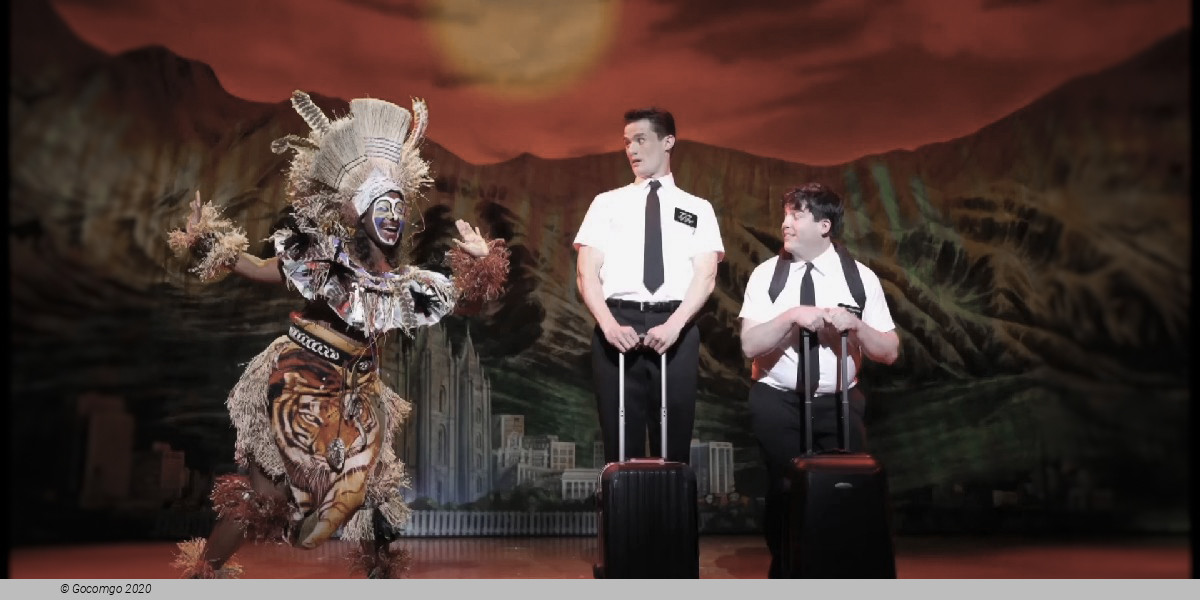
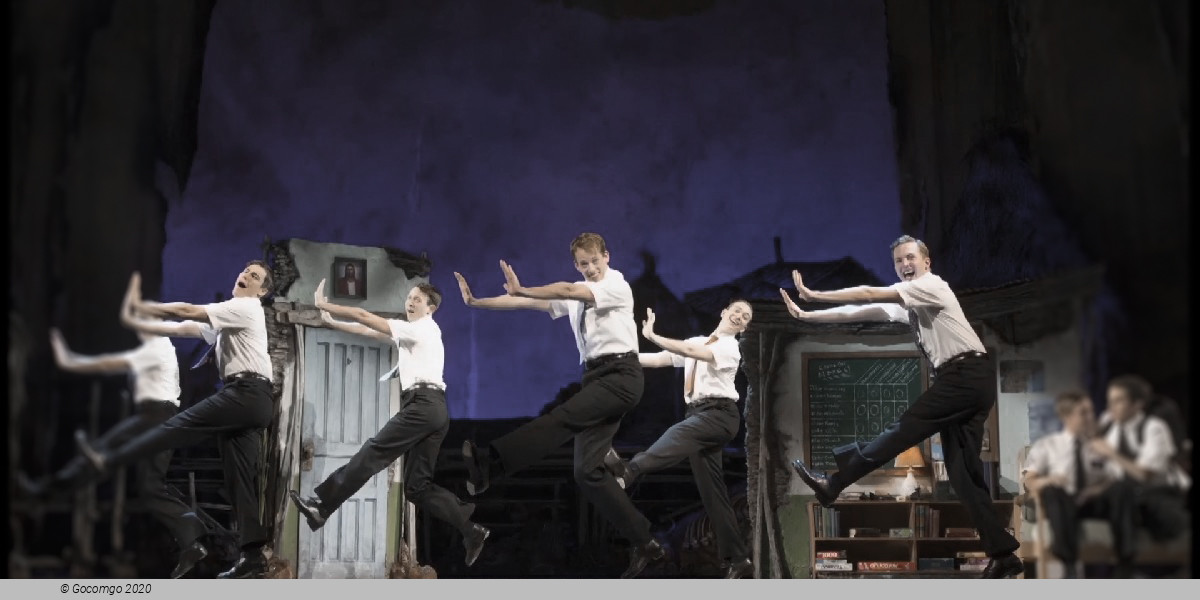
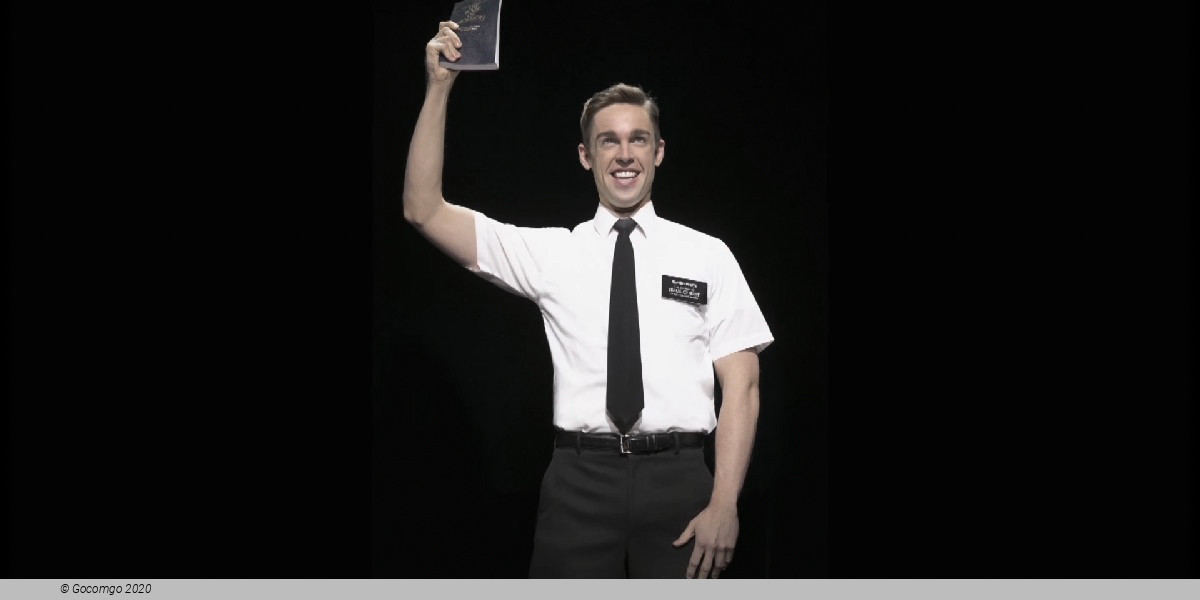
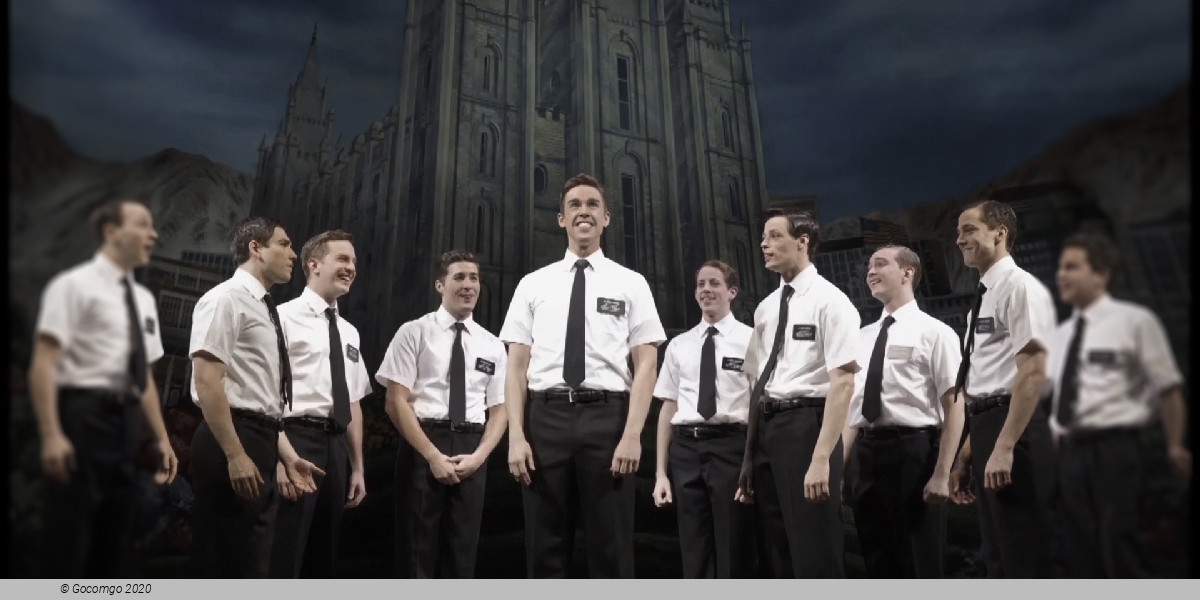
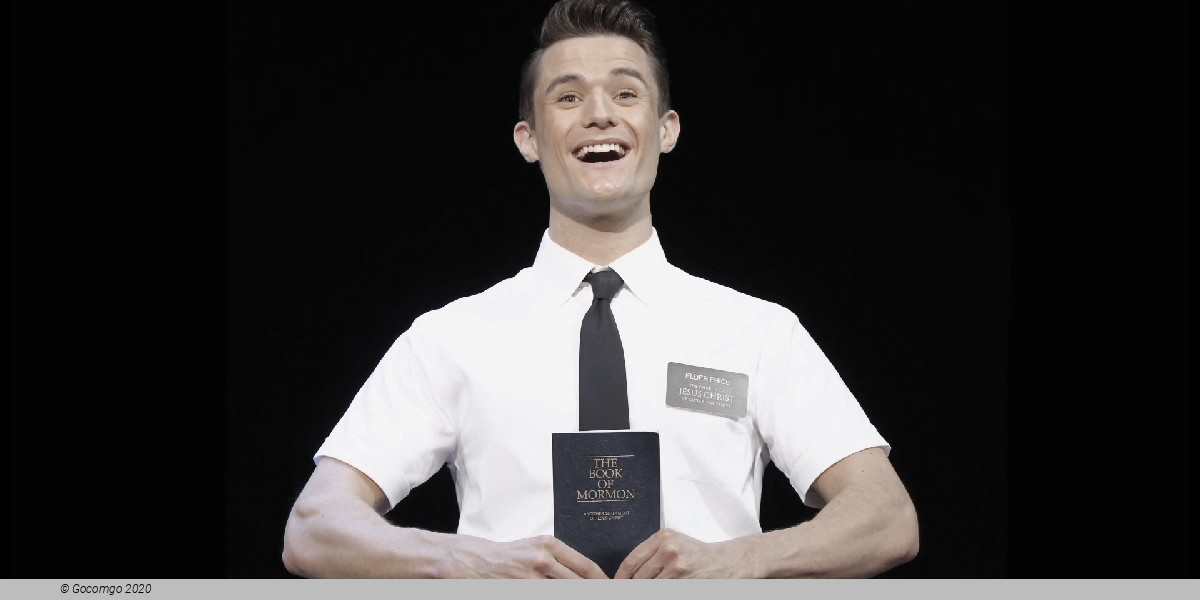
At an LDS Church Missionary Training Center, devout missionary-to-be Elder Kevin Price leads his classmates in a demonstration of the door-to-door method to convert people to The Church of Jesus Christ of Latter-Day Saints ("Hello!"). Price believes if he prays enough, he will be sent to Orlando, Florida for his two-year mission. However, he and Elder Arnold Cunningham, an insecure, compulsive liar, find out that they will instead be sent to Uganda as a pair ("Two by Two"). Price is sure he is destined to do something incredible, while Cunningham is just happy to follow ("You and Me (But Mostly Me)").

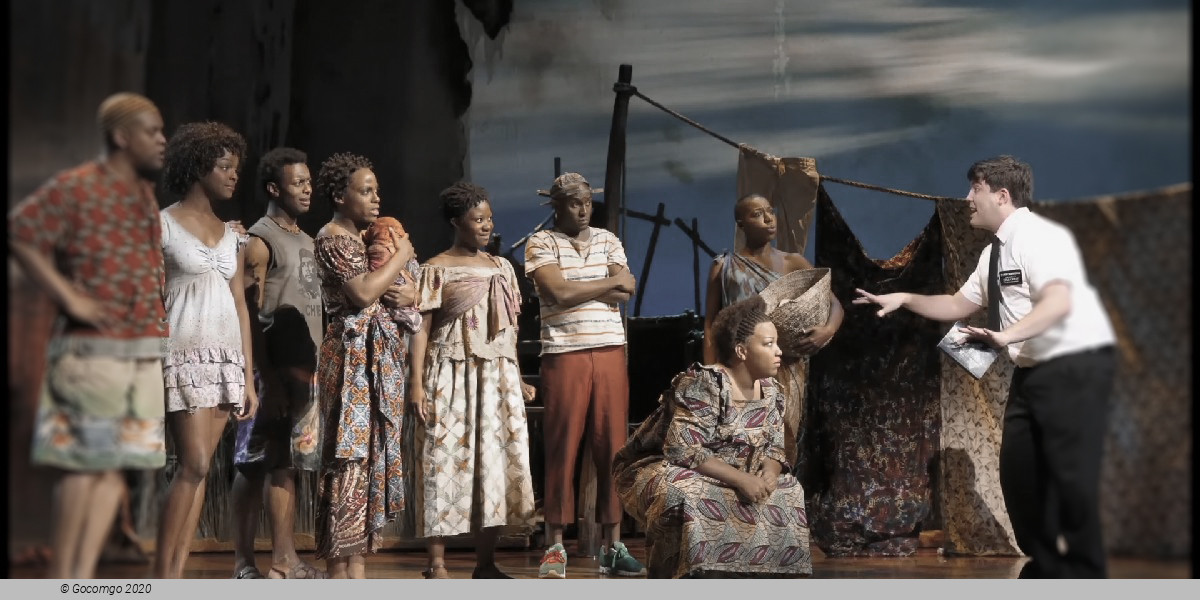
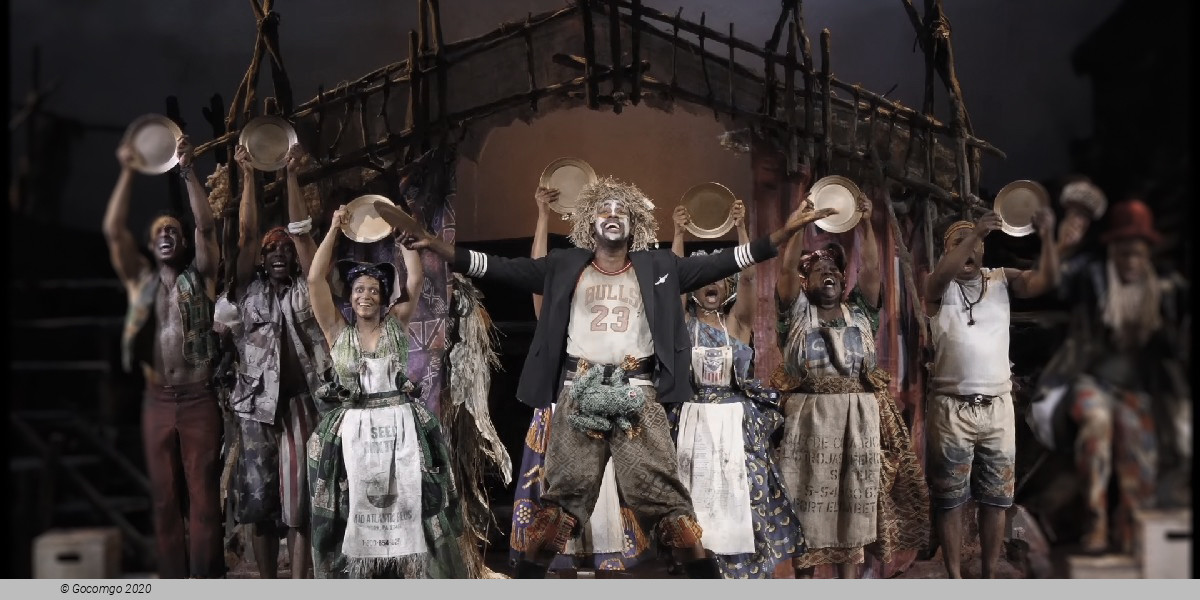
Upon arrival in northern Uganda, the two are robbed by soldiers of a local warlord, General Butt Fucking Naked. They are welcomed to the village by Mafala Hatimbi, where a group of villagers share their daily reality of living in appalling conditions while being ruled by the General. To make their lives seem better, the villagers repeat a phrase that translates as "Fuck you, God!" ("Hasa Diga Eebowai").

Price and Cunningham are led to their living quarters by Nabulungi, Hatimbi's daughter. They meet their fellow missionaries stationed in the area, who have been unable to convert anyone to the Church. Elder McKinley, the district leader, teaches Price and Cunningham thought suppression ("Turn It Off"). By the time they go to bed that night, Price is riddled with anxiety, but Cunningham reassures him that he will succeed and that, as his companion, Cunningham will be by his side no matter what ("I Am Here for You").

Price is confident he can succeed where the other elders have failed, teaching the villagers about Joseph Smith through a song that begins as a tribute to Smith but eventually descends into a tribute by Price to himself ("All-American Prophet"). The General arrives and announces his demand for the genital mutilation of all female villagers. After a villager protests, the General murders him. Taking every last measure to protect her, Hatimbi commands Nabulungi to stay in their house with all the doors locked and windows closed. She protests, insisting that the women of the village won't have to stay in hiding if they listen to the missionaries, as they hold the secrets to liberation, protection, and eternal happiness. Though her protests to go out and talk to them fail, she calms down after remembering how she was moved by Price's promise of an earthly paradise and dreams of going to live in that new land with all of her fellow villagers ("Sal Tlay Ka Siti").

The mission president has requested a progress report on their mission. Shocked by the execution and the reality of Africa, Price decides to abandon his mission and requests a transfer to Orlando. At the same time, Cunningham, ever loyal, assures Price he will follow him anywhere ("I Am Here for You [Reprise]"). However, Price unceremoniously dumps him as mission companion. Cunningham is crushed and alone, but when Nabulungi comes to him, wanting to learn more about the Book of Mormon and having convinced the villagers to listen to him, Cunningham finds the courage to take control of the situation ("Man Up").

Act II
When the villagers begin to get frustrated at Cunningham's teaching of the Book of Mormon and leave, Cunningham quickly makes up stories by combining what he knows of LDS doctrine with pieces of science fiction and fantasy. Cunningham's conscience (personified by his father, Joseph Smith, Hobbits, Lt. Uhura, Darth Vader, and Yoda) admonishes him, but he rationalizes that if it helps people, it surely cannot be wrong ("Making Things Up Again"). Price joyfully arrives in Orlando but then realizes that he is dreaming when his father questions him on if he left his mission companion. He is reminded of the nightmares of hell he had as a child and panics when his nightmare begins again ("Spooky Mormon Hell Dream"). During this dream he sees Jesus, Satan, Genghis Khan, Jeffrey Dahmer, Adolf Hitler, and Johnnie Cochran. Price awakens and decides to re-commit to his mission.

Cunningham announces several Ugandans are interested in the church. McKinley points out that unless the General is dealt with, no one will convert. Price, seeing the chance to prove his worth, sets off on the "mission he was born to do." After re-affirming his faith, he confronts the General, determined to convert him ("I Believe"). The General is unimpressed and drags Price away.

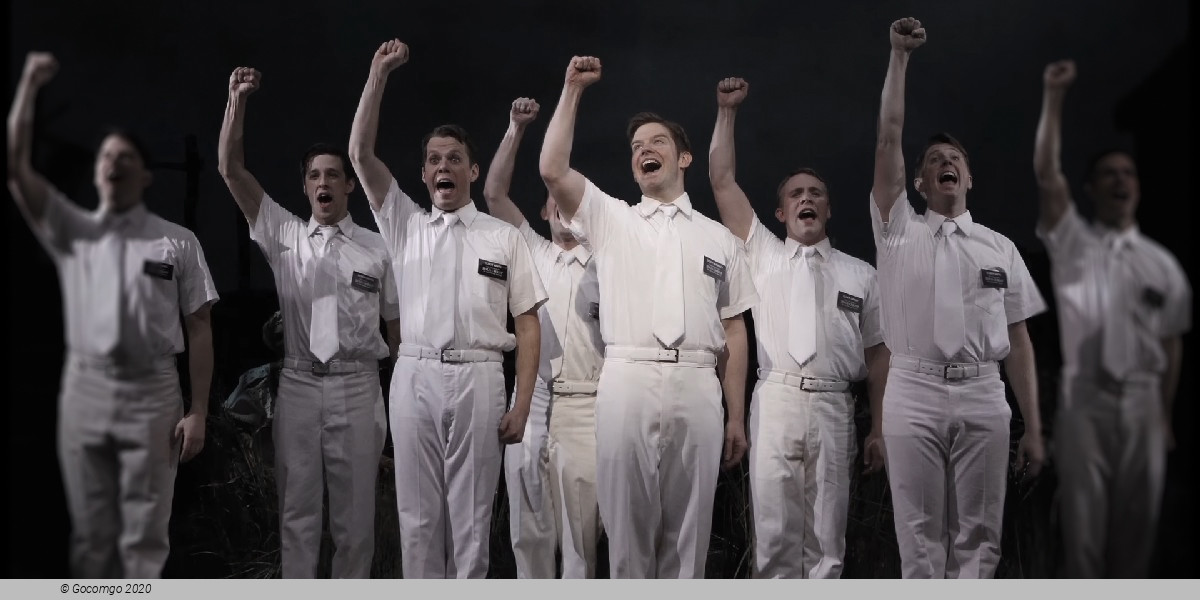
Cunningham concludes his preaching, and the villagers are baptized, with Nabulungi and Cunningham sharing a tender moment as they do ("Baptize Me"). The missionaries feel oneness with the people of Uganda and celebrate ("I Am Africa"). Price is seen in the village doctor's office, having the Book of Mormon removed from his rectum. Meanwhile, the General hears of the villagers' conversion and resolves to kill them all.

Having lost his faith, Price drowns his sorrows in coffee. Cunningham finds Price and tells him they need to at least act like mission companions, as the mission president is coming to visit the Ugandan mission. Price reflects on all the broken promises the church, his parents, his friends, and life in general made to him.

Nabulungi and the villagers perform a pageant for the mission president to "honor [them] with the story of Joseph Smith, the American Moses" ("Joseph Smith American Moses"), which reflects the distortions put forth by Cunningham, such as having sex with a frog to cure their AIDS. The mission president is appalled, orders all the missionaries to go home, and tells Nabulungi that she and her fellow villagers are not members. Nabulungi, heartbroken at the thought that she will never reach paradise, curses God for forsaking her ("Hasa Diga Eebowai [Reprise]"). Price has had an epiphany and realizes Cunningham was right all along: though scriptures are important, what is more important is getting the message across ("You and Me (But Mostly Me) [Reprise]").

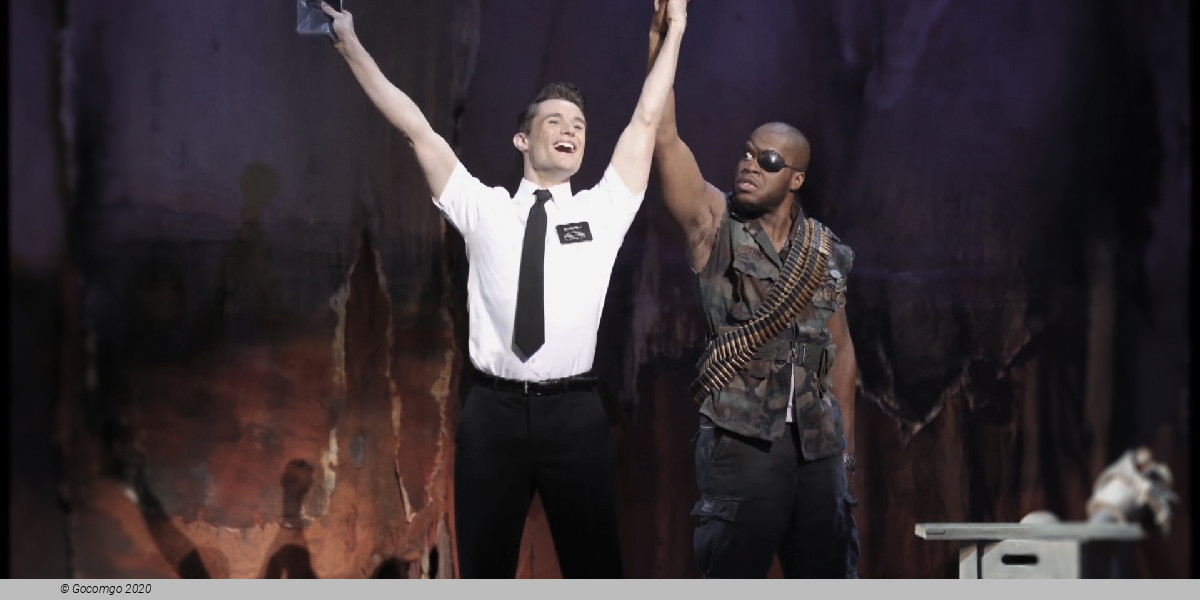
The General arrives, and Nabulungi is ready to submit to him, telling the villagers that Cunningham's stories are untrue. She also explains that they will never see him again but protects his reputation in their eyes by saying a lion ate him. To Nabulungi's shock, they respond that they have always known that the stories were metaphors rather than the literal truth. Price and Cunningham arrive just in time to use Cunningham's lies of the latter being resurrected after being eaten by lions to scare the General and his men away. Price rallies the members of the Church and the Ugandans to work together to make this their paradise. Later, the newly minted Ugandan elders (including the General) go door to door to evangelize with "The Book of Arnold" ("Tomorrow Is a Latter Day"/"Hello! [Reprise]"/"Encore").

Venue Info

The Book of Mormon (Prince of Wales Theatre) - London
Location   Coventry St

The Prince of Wales Theatre is a West End theatre in Coventry Street, near Leicester Square in London. It was established in 1884 and rebuilt in 1937, and extensively refurbished in 2004 by Sir Cameron Mackintosh, its current owner. The theatre should not be confused with the former Scala Theatre in London that was known as the Prince of Wales Royal Theatre or Prince of Wales's Theatre from 1865 until its demolition in 1903. The theatre is now home to The Book of Mormon which has become the theatre's longest-running musical. This musical comedy is a satirical examination of the beliefs and practices of the Church of Jesus Christ of Latter-day Saints.

Phipps' theatre

The first theatre on the site opened in January 1884 when C.J. Phipps built the Prince's Theatre for actor-manager Edgar Bruce. It was a traditional three-tier theatre, seating just over 1,000 people. The theatre was renamed the Prince of Wales Theatre in 1886 after the future Edward VII. Located between Piccadilly Circus and Leicester Square, the theatre was favourably situated to attract theatregoers.

The first production in the theatre was an 1884 revival of W. S. Gilbert's The Palace of Truth starring Herbert Beerbohm Tree, preceded by a one-act comedy, In Honour Bound. This was soon followed by a free adaptation of Ibsen's A Doll's House, called Breaking a Butterfly. In 1885, Lillie Langtry, reputedly the first "society" lady to become an actress, played in Princess George and The School for Scandal. The first hit production at the theatre was the record-breaking comic opera, Dorothy, starring Marie Tempest, which was so successful that its authors used the profits to build the Lyric Theatre, where it moved in 1888. The wordless mime play L'Enfant Prodigue premiered in 1891 which, together with A Pierrot's Life in 1897, brought respectability to mime troupes in Britain. On 23 December 1886, Henry Savile Clarke and Walter Slaughter’s musical Alice in Wonderland (the first major production of the Alice books) debuted at the theatre, with Phoebe Carlo in the title role. Lewis Carroll attended a performance seven days later.

George Edwardes' musical play, In Town, often considered the first English musical comedy, was presented at the theatre in 1892 and was followed by Edwardes' even more successful A Gaiety Girl in 1893. In 1895, Basil Hood's Gentleman Joe, the Hansom Cabby began a long run starring the low comedian, Arthur Roberts, in the title role. The theatre then began to present straight plays with Maeterlinck's Pelléas et Mélisande (1898, with incidental music by Fauré) and Wills's adaptation of Dickens' A Tale of Two Cities as The Only Way (1899, also starring Harvey). Charles Hawtrey starred in the successful A Message from Mars (1901). In 1900–01, Marie Tempest played the title roles in the play English Nell (based on Simon Dale's novel about Nell Gwynn), Peg Woffington, a dramatisation of Charles Reade's novel, as well as Becky Sharp in a dramatisation of Thackeray's Vanity Fair.

The theatre played more musical comedies beginning in 1903, including the Frank Curzon and Isabel Jay hits Miss Hook of Holland (1907, its matinee version, Little Miss Hook of Holland was performed by children for children), King of Cadonia (1908), and The Balkan Princess (1910), and later the World War I hits, Broadway Jones (1914), Carminetta (1917), and Yes, Uncle! (1917).

The theatre then hosted plays such as Avery Hopwood's farce Fair and Warmer (1918) and Ivor Novello's The Rat (1924, Novello's first play, in which he also starred), and revues including A to Z (1921), Co-Optimists (1923), and Charlot's Revue (1924). They starred Gertrude Lawrence, Jack Buchanan, Beatrice Lillie, Stanley Holloway, and Jessie Matthews. Ms Matthews also starred, along with Richard Hearne, in "Wild Rose", featuring the memorable Jerome Kern song "Look for the Silver Lining". These were followed by The Blue Train (1927), Alibi (1928, directed by Gerald du Maurier with Charles Laughton as Hercule Poirot), By Candlelight (1928), and Journey's End (1929). In 1930, Edith Evans became the manager at the theatre, presenting and starring in Delilah, which was not a success. Beginning in 1932, the theatre presented a series of risqué "Folies"-style revues, including Voila! Les Dames (1935) and its last production, Encore les Dames (1937). These shows were so successful that they funded the rapid rebuilding of the theatre in 1937.

Cromie's theatre

After 50 years, the theatre's 800 seats were deemed insufficient for productions of the day, and it was demolished. On 17 June 1937, Gracie Fields sang to the workmen as she laid the foundation stone of the new Art Deco-decorated theatre, designed by Robert Cromie, and the theatre opened on 27 October that year. The new theatre's seating capacity was about 1,100, and it had a larger stage and improved facilities for both the artists and the public, including a large, stylish stalls bar (the bar itself was 14 metres long), complete with dance floor. The first productions at the new theatre were Les Folies de Paris et Londres, starring George Robey, followed by Folies De Can-Can in 1938, a continuation of the old theatre's series of successful risqué revues, which ran continuously until 2 am every night. The musical comedy, Present Arms, was offered in 1940, and in 1941 the theatre screened the UK premiere of Charlie Chaplin's The Great Dictator. The film had been banned in many parts of Europe, and the theatre's owner, Alfred Esdaile, was fined for showing it.

In 1943, Strike a New Note was notable for Sid Field's London debut, and he returned to the theatre in Strike it Again (1944), and yet again in Piccadilly Hayride (1946, a revue that ran for 778 performances). In 1949, Harvey, Mary Coyle Chase's comedy about an imaginary rabbit, was a success, as was Diamond Lil in 1948 starring Mae West. In the 1950s, the theatre hosted variety and revues, starring such famous performers as Norman Wisdom, Peter Sellers, Bob Hope, Gracie Fields, Benny Hill, Hughie Green, Frankie Howerd, and Morecambe and Wise. In 1959, Paul Osborn's The World of Susie Wong became the theatre's longest-running play to date with 832 performances. On 4 November 1963, The Beatles performed From Me to You, She Loves You, Till There Was You, and Twist and Shout at the Prince of Wales Theatre, during the Royal Variety Show in the presence of The Queen Mother.

Neil Simon's play, Come Blow Your Horn, starring Michael Crawford, played in 1962, followed by a season of Martha Graham's dance company, including the world première of her ballet Circe. Next was a string of Broadway musicals, including Funny Girl in 1966 with Barbra Streisand, Sweet Charity (1967), and Promises, Promises (1969). The Threepenny Opera was revived in 1972. In 1976, Bernard Slade's Same Time, Next Year was a hit, as was I Love My Wife (1977), and Bedroom Farce (1978). In 1982, Underneath the Arches was a long-running hit. Andrew Lloyd Webber's Aspects of Love (1989) smashed all previous box-office records at the theatre, running for 1,325 performances. More recent productions are listed below.

Refurbishment was carried out in 2004 to increase the seating capacity slightly to 1,160 seats and to modernise the theatre's facilities. New bars were added, the auditorium completely rebuilt, the backstage areas refurbished and the theatre's famous tower and exterior completely gutted and refurbished with new LED lighting and a crisp modern finish.

The theatre re-opened with ABBA's musical Mamma Mia! on 16 April 2004. On 18 August 2007, Mamma Mia! became the longest-running show ever at the Prince of Wales, overtaking the previous record held by Aspects of Love with 1,326 performances at the venue and counting. The production marked another landmark on Thursday 23 August 2007, celebrating its 3,500th performance since its 1999 world premiere at the Prince Edward Theatre in Old Compton Street, London. The production left the theatre on 1 September 2012 and transferred to the Novello Theatre on 6 September 2012.

After a short run of Let it Be, before it transferred to the Savoy for a short run, the theatre is now home to The Book of Mormon which has become the theatre’s longest running musical. 

The theatre was grade II listed by English Heritage in April 1999.

Important Info
Type: Musical
City: London, Great Britain
Starts at: 19:30
Acts: 2
Intervals: 1
Duration: 2h 20min
Top of page